December 15, 2011 at 9:52 am
· Filed under Agricultural Biotechnology, Consumer Attitudes About Biotechnology
Terry D. Etherton

One objective of my blog is to provide a public forum for presenting science-based facts about numerous issues that relate broadly to the use of biotechnologies and technologies for food production. In the spirit of my blog being a public forum, students in a first-year seminar course I taught this Fall (Animal Science 110S: Animal Biotechnology and Society) had to write a short blog about some aspect of biotechnology and agriculture.
My objective was for the students to learn about biotechnology AND engage in a learning activity about communicating science to society. I shared with the students that writing a blog would be a terrific learning experience about communicating science. You will be the “judge” of how well they did this. Read the rest of this entry »
Permalink
November 28, 2011 at 11:24 am
· Filed under Agricultural Biotechnology, Consumer Attitudes About Biotechnology, Science & Education, The Food System

LUDWIGSHAFEN, GERMANY, November 8, 2011 – Consumers’ interest in agriculture and personal respect for farmers is high, even in countries where less than two percent of the population works in agriculture, according to the BASF Farm Perspectives Study, which surveyed 1,800 farmers and 6,000 consumers. Yet farmers and consumers also agree that farmers’ reputations remain low. The study, which outlines the way farmers and consumers view the farming profession, its challenges and its support network, revealed surprisingly strong agreement on major issues, including the role of farmers and the major challenges farmers are facing in the 21st century. Read the rest of this entry »
Permalink
November 7, 2011 at 10:00 am
· Filed under Agricultural Biotechnology, Consumer Attitudes About Biotechnology, Science & Education, The Food System
Terry D. Etherton
This article was first published on the IFIC Food Insight Blog on November 4, 2011.
Sustainable is a popular word these days in conversations about the practices used to produce our food. The word is used and misused extensively.
I have asked many folks what sustainable food production means. The answers are diverse, and astonishing in some instances. Relative the latter, some convey that sustainable food production is the only “way” and that unsustainable agriculture doesn’t work. The latter response is more than puzzling to me. If the business is not economically sustainable then it is unsustainable. Read the rest of this entry »
Permalink
November 3, 2011 at 3:50 pm
· Filed under Ag Biosecurity, Agricultural Biotechnology, Consumer Attitudes About Biotechnology, Science & Education, The Food System
Terry D. Etherton
The public discussion about the need for adequate food is a luxury that well-fed people in developed countries can afford. But in developing countries where the population is growing while the supply of farmland shrinks, people are grappling with a much thornier and higher-stakes dilemma. Unless they can grow more food on less land, they may not have enough to eat. The scale of this is already daunting – more than 1 billion individuals in the world go to bed each night hungry. Read the rest of this entry »
Permalink
October 11, 2011 at 11:43 am
· Filed under Ag Biosecurity, Consumer Attitudes About Biotechnology, Science & Education, The Food System
By Charlie Dunmore
BRUSSELS | Tue Oct 11, 2011
(Reuters) – Europe’s biotechnology industry has warned the European Commission that agricultural imports vital to EU food security are increasingly being put at risk, due to the slow pace of the bloc’s approval system for genetically modified (GM) crops.
In a report to be presented to EU policymakers on Tuesday, biotech association EuropaBio said the speed of GM crop authorizations in Europe is slowing — even as governments worldwide seek to step up the pace of their approvals.
“The EU authorization process for GM products takes substantially longer than comparable systems, despite the fact that government processes around the world to assess the safety and impact of GM products are essentially the same,” it said. Read the rest of this entry »
Permalink
August 18, 2011 at 4:48 pm
· Filed under Consumer Attitudes About Biotechnology, Science & Education, The Food System
Terry D. Etherton

I have spent about 30 years traveling down the “road” of trying to communicate science to the public. It has been an interesting journey. I launched my blog, Terry Etherton Blog on Biotechnology, in 2006 for many reasons, including the idea of providing science-based facts for consumers about many public discussions around food biotechnology in which activists and activist groups try to scare consumers.
During this journey, I have come to appreciate the tremendous need for scientists to become more proactive in communicating science. Specifically, the scientific community needs to be much better at conveying what they do and how science and technology benefit consumers. I have written about this, most recently in Please Explain: Training Scientists to be Better Communicators imploring scientists to get involved.
In my travels down this “road”, I have become sensitized to the issue of how is the information I present being “heard” by the audience. This can be a real adventure, especially when some in the “audience” share “they don’t believe the message(s)” or messenger (i.e., me). This raises the interesting question of what to do? Read the rest of this entry »
Permalink
June 27, 2011 at 5:01 pm
· Filed under Consumer Attitudes About Biotechnology, Science & Education, The Food System
Terry D. Etherton

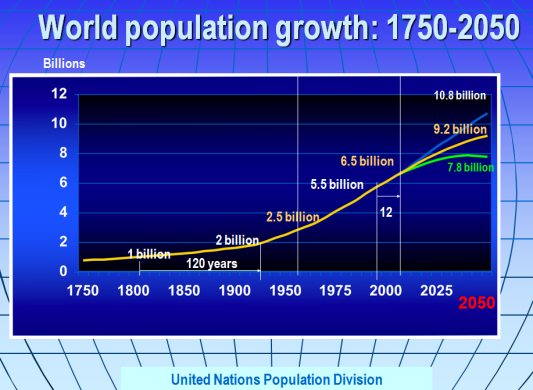
Much has been written by others and myself about the need to feed a growing World population that will increase to between 9 and 10 billion individuals by 2050 (based on estimates from the Population Estimates and Projections Section of the UN). Making projections about the impact of population growth on food production raises the question of just how much food will be required to feed 10 billion people? While the question is straightforward, developing these estimates is remarkably challenging. The vast majority of numbers are derived from food disappearance data, that is food for human consumption that is produced is assumed to “disappear” via consumption. This is problematic, in part, because it has been estimated that 30 to 40% of food in developed and developing countries is wasted (Godfray et al., 2010). This wastage spans the spectrum of the food system from production to plate waste.
The question emerges, then, of whether there is more accurate approach for estimating projected food needs in 2050? Read the rest of this entry »
Permalink
April 20, 2011 at 10:36 am
· Filed under Agricultural Biotechnology, Consumer Attitudes About Biotechnology, Science & Education, The Food System
Terry D. Etherton

Recently, a compelling and persuasive article was published by Dr. Jonathan D. G. Jones in a scientific journal (the Philosophical Transactions of the Royal Society) entitled “Why Genetically Modified Crops“. In the article, Dr. Jones shares his exasperation over the widespread misrepresentation of genetically modified (GM) plant science. Importantly, he presents that rationale (that is widely accepted by the scientific community) that adopting GM crops is essential for agriculture in the future because it reduces its environmental impact by reducing pesticide applications and conserving soil carbon by enabling low till methods. Dr. Jones concludes with the perspective that “it would be perverse to spurn this approach at a time when we need every tool in the toolbox to ensure adequate food production in the short, medium and long term”. Read the rest of this entry »
Permalink
March 21, 2011 at 7:20 pm
· Filed under Consumer Attitudes About Biotechnology, Organic, Science & Education, The Food System
Terry D. Etherton
Is your preference to shop for and purchase “natural” foods? Based on some of my observations in a few trips recently to the West Coast and Texas, there are some segments of the restaurant and grocery store industries where the usage of this phrase has gotten completely out-of-hand. Every time I hear “natural foods”, I always wonder what isn’t “natural”? Of course, that isn’t the point of marketing, which should be to communicate succinctly…no, in the food industry one seems to need phrases that are poetic and differentiate some foods as a whole lot better, safer and healthier even when they are not! Read the rest of this entry »
Permalink
January 6, 2011 at 2:13 pm
· Filed under Agricultural Biotechnology, Consumer Attitudes About Biotechnology, Science & Education
Terry D. Etherton

There was a very interesting article, Seed of Change: America may Shift its Policy on Genetically Modified Crops, published in The Economist on January 6, 2011 about the mess that potentially has been created by USDA Secretary Vilsack and his “coexistence plan” for oversight of Roundup Ready® Alfalfa. I had written about the “coexistence plan” in a blog Luddites at the USDA Door that I posted earlier this week. I encourage you to read the article in The Economist.
Permalink