Feeding the World and Defending Agricultural Science
Terry D. Etherton
As readers of my blog have observed, I have not posted a blog for a few months. About all that could be written about the battle over application of rbST in the dairy industry in the United States, and defending the freedom of dairy farmers to use safe and effective technologies has been discussed. The stories currently being written by opponents of this biotechnology are simply a rehash of a rehash…nothing new. This all has been chronicled in Terry Etherton Blog on Biotechnology.
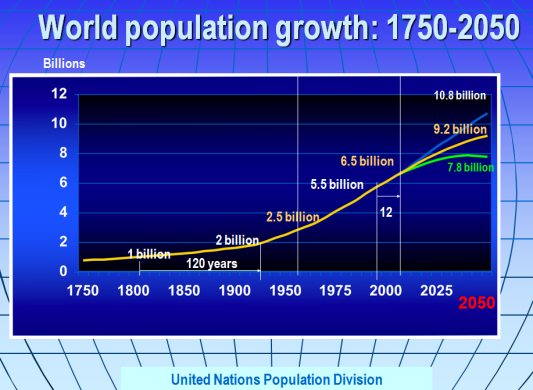
There are other issues confronting society and agriculture that are enormous challenges and merit debate about how to solve them. One pressing issue that looms on the horizon pertains to how the global village is going to feed a growing world population. Projections are that between now and 2050, the world’s population will grow from 6.5 billion to about 10 billion people (International Service for the Acquisition of Agri-Biotech Applications – ISAAA). Another “metric” that hammers home the challenge that lies ahead is that the amount of cultivable crop land for food production (on a per capita basis) is plummeting. In 1966, there was about 0.45 hectares (ha) per person in the World – in 2050 the projections are that this will be approximately 0.15 ha (ISAAA).
The shrinking land base (on a per capita basis) is very problematic. Many presume that climatic conditions will be stable and not adversely affect food production. That is not a given, however. In addition, geo-political strife is ever present, and affects food production and distribution. Moreover, it is not easy to predict future conflicts and what impact they might have on the food system. The other “wild card” that has a huge potential impact to up heave food production is a targeted strike on food production via a bioterrorism attack.
The question society confronts is very simple – how are we are going to feed the growing World population? I don’t think many would endorse the idea of chopping down more rain forest to expand acreage for food production. Science and new innovations are needed – new technology-based products will have to be developed and applied. A key target for application of new science-based solutions will be to improve food production efficiency, i.e., more apples per tree, more milk per unit of feed consumed by a dairy cow, etc.
An “ugly” reality intertwined in this issue is the cost of discovering and developing the science, and distributing the new technologies (and food) to both developed and developing countries. This will be enormously challenging! Will developed countries be willing to cover the costs to do this? Is there the political “will” to do this?
The current world-wide economic crisis is a daunting problem. A March 5, 2009 editorial in the New York Times (The Crisis at Home and Abroad) observed that the European Union’s wealthy members rejected calls for a bailout from its poorer members. This is not encouraging illustration that rich countries will provide assistance to poorer or developing countries.
Another emerging challenge is that there is evidence that cereal crop reserves are decreasing. If there are a couple of “bad” food production cycles in the World, the amount of food reserves becomes critical.
These issues are going to be the ones that I focus on in my blogs over the next few months. The issue of feeding the growing World population is complex. In addition, many consumers in developed countries simply don’t see the “problem” because their grocery store shelves are full. I wonder what would happen in America if consumers went to the grocery store and only half of the food was there?